Learning Resources
This page provides a curated collection of learning materials for students and joining collaborators.
The resources are organized progressively, from foundational concepts (e.g. for undergrad. students) to advanced reference materials.
Nuclear Physics at JLab and EIC
Introductory materials for the physics at Jefferson Lab (JLab) and the upcoming Electron-Ion Collider (EIC).
Jefferson Lab
Introductory videos overview the science at Jefferson Lab and the fundamental questions we're working to answer.
Introduction to Jefferson Lab:
- Jefferson Lab: Exploring the Nature of Matter
- The 12 GeV Upgrade
- Inside the Nucleus
- Charting the Inner Structure of the Proton
The Electron-Ion Collider
The EIC represents the next frontier for understanding hadron structure. These resources introduce the science case and the facility.
- Why Electron Ion Collider (very high level)
- Electron-Ion Collider at Brookhaven — Official EIC website with science highlights and project updates
- EIC Visual Gallery — Detector concepts, facility designs, and physics illustrations
Core Physics Background
Quarks and Leptons: An Introductory Course in Modern Particle Physics
Halzen & Martin — PDF
This is the standard graduate-level textbook for particle physics. It covers the Standard Model, scattering theory, and the formalism underlying our measurements. Particularly useful chapters include those on deep inelastic scattering and the parton model.
Particle Data Group (PDG) Review of Particle Physics
PDG 2025 Reviews
The PDG is an invaluable reference for anyone in particle physics. For our work, the following sections are particularly relevant:
- kinematics (definitions of kinematic variables and relativistic relations),
- cross sections (formalism for scattering calculations),
- particle detectors (resolution formulas, detector response),
- and form factors (electromagnetic structure of hadrons).
Introduction to Relativistic Kinematics and Scattering
Xiaochao Zheng — PDF
A pedagogical introduction that builds from four-vectors to scattering cross sections, designed for students working on JLab projects.
Particle Detectors
- Particle Detectors in Nuclear Physics — Lecture on detector principles (JLab, Fenker)
- Introduction to Particle Detectors — CERN summer school lecture
- Calorimetry in High Energy Physics — Detailed treatment of calorimeter physics (DESY, Garutti)
Meson Structure Theory and Formalism
These papers contain the theoretical framework and equations used in our analyses.
Theory Papers
Pion and Kaon Structure at the Electron-Ion Collider
Aguilar et al. — arXiv:2102.11788
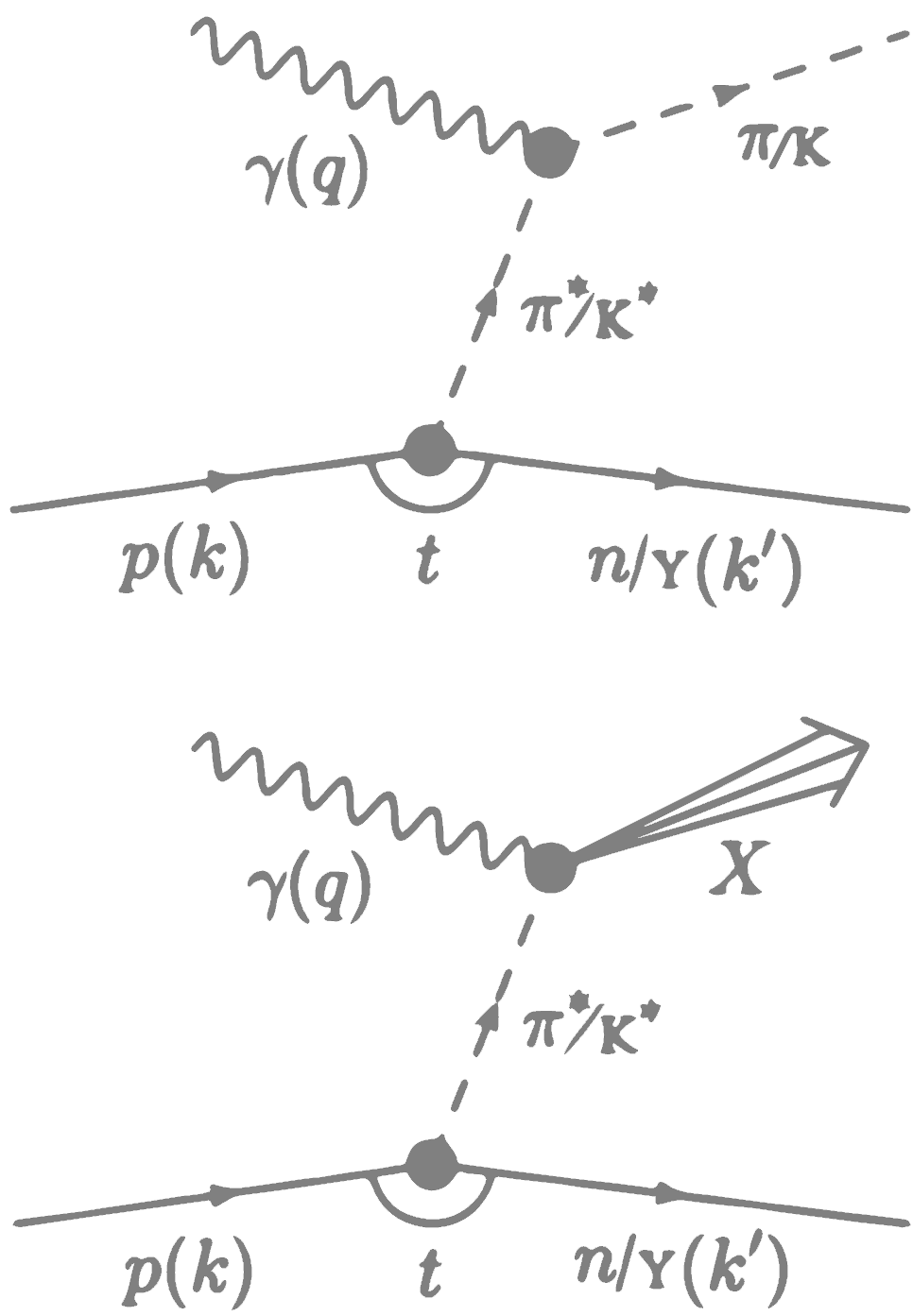
This review covers the theory of meson structure functions, including the formalism for Sullivan process measurements and the physics case for EIC studies. Note that this paper is theory-heavy but provides the complete mathematical framework underlying our work.
Insights into the Emergence of Mass from Studies of Pion and Kaon Structure
Arrington et al. — arXiv:2102.01765
Connects meson structure measurements to fundamental questions about mass generation in QCD. Includes discussion of both experimental approaches and theoretical predictions.
Foundational Experimental and Phenomenology Papers
These references from the Meson Structure Functions wiki provide important background on the experimental techniques and theoretical framework.
EIC White Paper
Accardi et al., Eur. Phys. J. A52 (2016) no.9, 268
The comprehensive science case for the Electron-Ion Collider, including meson structure physics. Essential reading for understanding the broader context of our measurements.
Leading Neutron Production in e+p Collisions at HERA
Nucl. Phys. B 637 (2002) 3-56
The ZEUS measurement of leading neutron electroproduction, which established the experimental technique we build upon.
Pion Structure Function from Leading Neutron Electroproduction and SU(2) Flavor Asymmetry
Connects leading baryon measurements to pion structure extraction.
Phenomenological Implications of the Nucleon's Meson Cloud
Theoretical framework for understanding how mesons contribute to nucleon structure.
JLab Measurement Proposals
Group Publications
Our group has contributed several key papers to the field. These represent the methods and results that define our current research program.
Software and Computing Environment
Prerequisites
Before beginning analysis work, ensure you have:
- A GitHub account (any account can fork and create Pull Requests)
- Familiarity with Python and/or C++ for analysis code
- Basic command-line proficiency
Setting Up Your Environment
If you are new to EIC software, the centralized EPIC tutorials provide step-by-step guidance. The essential tutorials are:
- Setting up the environment — Installing and configuring the EIC software stack
- Analysis and working with simulation output — Reading and analyzing simulated data
Contributing to Our Code
Our analysis code lives in the JeffersonLab/meson-structure repository.
For JeffersonLab organization members: You can create branches and push changes directly.
For external collaborators: Fork the repository and submit Pull Requests. If you need direct push access, contact the repository maintainers to be added to the developers list.
Questions?
If you need clarification on any of these materials or suggestions for additional resources tailored to your background, reach out to your mentors or post in our group communication channels.